© by Gerald So | 12:00 N
It's been another good month in terms of time spent writing. Acceptances? Not yet. Apparently one of my stories was in final consideration for Shotgun Honey Presents Vol. 4, but was not selected.
I spent a day or so wondering how close it came. Then I remembered Black Cat Mystery Magazine is open to general (non-PI) submissions through November 30. I considered simply formatting and sending the finalist manuscript. My consideration became practically re-imagining the story. Then I reworked that and submitted to Black Cat this morning.
I've had the germ of this story since 1995. I hope my efforts are on target. I always hope and I never know, realities of putting work in someone else's hands.
Showing posts with label On Writing. Show all posts
Showing posts with label On Writing. Show all posts
Saturday, November 23, 2019
Thursday, October 31, 2019
A Good Month
© by Gerald So | 7:30 AM
On August 30, I submitted a 1,300-word story to Black Cat Mystery Magazine's upcoming all-PI issue. Black Cat's normal turnaround time is 1-2 weeks. The longer they hold a story, the more they like it, apparently, and my story was held until October 3. I'd like to think that means it was close to being accepted, but the special issue evidently drew much more than the usual number of submissions, probably causing a delay.
I revised the story for the next eight days and submitted it to Ellery Queen's Mystery Magazine. They held it for eleven days, three more than my previous submission there, including a slightly more hopeful rejection.
I revised further and sent the story to a third market. Tomorrow I'm submitting another story to Cheap Pop Lit and should be hearing from an anthology about a third that began a gleam in my eye twenty-four years ago. Stay tuned, true-believers.
On August 30, I submitted a 1,300-word story to Black Cat Mystery Magazine's upcoming all-PI issue. Black Cat's normal turnaround time is 1-2 weeks. The longer they hold a story, the more they like it, apparently, and my story was held until October 3. I'd like to think that means it was close to being accepted, but the special issue evidently drew much more than the usual number of submissions, probably causing a delay.
I revised the story for the next eight days and submitted it to Ellery Queen's Mystery Magazine. They held it for eleven days, three more than my previous submission there, including a slightly more hopeful rejection.
I revised further and sent the story to a third market. Tomorrow I'm submitting another story to Cheap Pop Lit and should be hearing from an anthology about a third that began a gleam in my eye twenty-four years ago. Stay tuned, true-believers.
Saturday, August 31, 2019
No Time to Write?
© by Gerald So | 3:30 AM
This post title plays on the latest James Bond movie title, No Time to Die. Reading a Shortmystery digest message on August 22, I learned submissions were open July 1–August 31 for an all-PI story issue of Black Cat Magazine.
Having finally learned my lesson from term papers, I dislike deadline pressure and try to write and submit with plenty of time. Given these work habits, I thought of skipping the opportunity. The prevailing thought was to see if I could devise and finish a story in nine days.
I've developed a planning method that's worked well for my previous few stories, and I started running the germ of an idea through it, but I didn't have time to both draft the story and check it against my planning method as I went.
There are ideas that look good in planning that don't work in execution. If I spent too much time planning, I might not finish writing. I had to be writing as ideas formed to quickly see if they worked or not. As in a maze, I could see the end but needed to pick the right way there. As soon as I realized I picked wrong, I would start over
I also gave up my daily TV and exercise time to write. I still stepped back from the story now and then, but forced myself to shorten these breaks—including sleep—to get back to writing as soon as possible.
Even with this level of focus, there were times it seemed I wouldn't have a full story by the deadline, that ideas weren't coming. For hours I'd rewrite the same paragraph, trying to find an angle on the story. I was very conscious of leading readers down the right path, having the right mix of narration and action. Very often, narration can ramble without moving the story.
With two days to go, I received an email from my friend Graham Powell. I mentioned going for the deadline. He said he'd submitted earlier in the week and hoped both our stories would make it. That was a boost.
Wrapping up, somehow the story came together despite several times I thought it wouldn't, and I submitted yesterday. More and more I'm convinced inspiration isn't sudden. It comes from somewhere. We just don't always track its path. Doing all of the above positioned me to finish in time. Acceptance would be the ultimate victory, but submitting was a big one.
This post title plays on the latest James Bond movie title, No Time to Die. Reading a Shortmystery digest message on August 22, I learned submissions were open July 1–August 31 for an all-PI story issue of Black Cat Magazine.
Having finally learned my lesson from term papers, I dislike deadline pressure and try to write and submit with plenty of time. Given these work habits, I thought of skipping the opportunity. The prevailing thought was to see if I could devise and finish a story in nine days.
I've developed a planning method that's worked well for my previous few stories, and I started running the germ of an idea through it, but I didn't have time to both draft the story and check it against my planning method as I went.
There are ideas that look good in planning that don't work in execution. If I spent too much time planning, I might not finish writing. I had to be writing as ideas formed to quickly see if they worked or not. As in a maze, I could see the end but needed to pick the right way there. As soon as I realized I picked wrong, I would start over
I also gave up my daily TV and exercise time to write. I still stepped back from the story now and then, but forced myself to shorten these breaks—including sleep—to get back to writing as soon as possible.
Even with this level of focus, there were times it seemed I wouldn't have a full story by the deadline, that ideas weren't coming. For hours I'd rewrite the same paragraph, trying to find an angle on the story. I was very conscious of leading readers down the right path, having the right mix of narration and action. Very often, narration can ramble without moving the story.
With two days to go, I received an email from my friend Graham Powell. I mentioned going for the deadline. He said he'd submitted earlier in the week and hoped both our stories would make it. That was a boost.
Wrapping up, somehow the story came together despite several times I thought it wouldn't, and I submitted yesterday. More and more I'm convinced inspiration isn't sudden. It comes from somewhere. We just don't always track its path. Doing all of the above positioned me to finish in time. Acceptance would be the ultimate victory, but submitting was a big one.
Friday, January 25, 2019
Examining Expletives
© by Gerald So | 7:00 AM
Even among fans of crime fiction, where the most terrible things happen to innocent characters, some still object to profanity in the prose. Earlier this week on SleuthSayers, Barb Goffman analyzed how often she uses expletives in her fiction and asked readers if she had gone too far in her new Flash Bang Mysteries story, "Punching Bag".
In my comments, I explained that my parents never used profanity at home. If they reached the level of anger or frustration where other people curse, I never knew because it didn't show in their language. I heard profanity everywhere else: school, friends, books, movies. I can curse, but I generally don't because it didn't get me anywhere with my parents.
Similarly, if someone addresses me with inflammatory language, I give the language no credit and try to reach the issues behind it.
In creative writing, though, all words are tools to be used for precise effect. Click over and read Barb's post and the comments. Mine include my own look at specific expletives and what I cringe at reading, and why.
Your comments welcome here or there.
Even among fans of crime fiction, where the most terrible things happen to innocent characters, some still object to profanity in the prose. Earlier this week on SleuthSayers, Barb Goffman analyzed how often she uses expletives in her fiction and asked readers if she had gone too far in her new Flash Bang Mysteries story, "Punching Bag".
In my comments, I explained that my parents never used profanity at home. If they reached the level of anger or frustration where other people curse, I never knew because it didn't show in their language. I heard profanity everywhere else: school, friends, books, movies. I can curse, but I generally don't because it didn't get me anywhere with my parents.
Similarly, if someone addresses me with inflammatory language, I give the language no credit and try to reach the issues behind it.
In creative writing, though, all words are tools to be used for precise effect. Click over and read Barb's post and the comments. Mine include my own look at specific expletives and what I cringe at reading, and why.
Your comments welcome here or there.
Wednesday, November 07, 2018
Damn Fine Story by Chuck Wendig
© by Gerald So | 11:00 AM
Very early, Chuck Wendig states his 2017 Writer's Digest book is not a book of writing advice or answers. It might more accurately be characterized as an interrogation of how storytelling works across all media. How does it enthrall an audience? Of course, with each story told, these questions and more may be asked anew.
The book itself unfolds in a humorous, attention-holding style using such pop culture touchstones as the Star Wars movies, Die Hard, The Princess Bride, and Buffy the Vampire Slayer to take a fresh look at traditional writing advice, asking what it means at heart, and when necessary, rightfully debunking it.
Very early, Chuck Wendig states his 2017 Writer's Digest book is not a book of writing advice or answers. It might more accurately be characterized as an interrogation of how storytelling works across all media. How does it enthrall an audience? Of course, with each story told, these questions and more may be asked anew.
The book itself unfolds in a humorous, attention-holding style using such pop culture touchstones as the Star Wars movies, Die Hard, The Princess Bride, and Buffy the Vampire Slayer to take a fresh look at traditional writing advice, asking what it means at heart, and when necessary, rightfully debunking it.
Friday, October 19, 2018
The Vivid, Continuous Dream
© by Gerald So | 3:00 AM
The late writer and teacher John C. Gardner called the best fiction a vivid, continuous dream. Yesterday I submitted a story to its third market two years, arguably the toughest of the three to crack.
Leading up to submission, out of respect for the market, I revised the story all hours for twenty-three straight days. It truly filled my consciousness. The dream of this story, though, began in a workshop with Sam Topperoff at Hofstra University in 1995. At the time, I thought it would be a novel.
College was a heady time for me, as I'm sure it is for everyone. I felt it had the most potential to shape my life of any time in my life. I felt it was the right time to meet someone and fall in love. It so happened, and that raw emotion fueled the novel for sixty pages, the workshop minimum. I then put the idea away as too personal, until November 2016. Surprising myself, I was able to rekindle my enthusiasm to work with the characters and world.
(An aside: "Personal" here doesn't mean very autobiographical. It means I'm rooting for this story's success less objectively than I have most of my other work.)
Friends with whom I've shared the various drafts said I should blog about the story's journey. Ideally I'd blog about it upon acceptance, when its journey ended, but among many things I've learned working on it is ultimate acceptance doesn't matter to me as a working writer. What matters as I work is communicating what I imagine and feel, so well that someone with no prior personal connection—who simply reads the words—will imagine and feel very much the same. Self-publishing is not an option. I want to know I've made the connection with an impartial editor.
One of the quirks I work with is I'm very open to revision. I believe it can, and sometimes should, reshape stories entirely. That's certainly been true in this case. Versions have gone from however long the novel would have been, to 1,100 words, to 2,500 words, to 1,500 words, to 1,300 words. As such, I can lose the sense of whether a story would be as compelling for someone else as it is for me. I guess the sign of that is whether it's published. I say acceptance doesn't matter because I know until it's accepted—until it lives as vividly for someone else as it does for me—I'll keep working on it.
The late writer and teacher John C. Gardner called the best fiction a vivid, continuous dream. Yesterday I submitted a story to its third market two years, arguably the toughest of the three to crack.
Leading up to submission, out of respect for the market, I revised the story all hours for twenty-three straight days. It truly filled my consciousness. The dream of this story, though, began in a workshop with Sam Topperoff at Hofstra University in 1995. At the time, I thought it would be a novel.
College was a heady time for me, as I'm sure it is for everyone. I felt it had the most potential to shape my life of any time in my life. I felt it was the right time to meet someone and fall in love. It so happened, and that raw emotion fueled the novel for sixty pages, the workshop minimum. I then put the idea away as too personal, until November 2016. Surprising myself, I was able to rekindle my enthusiasm to work with the characters and world.
(An aside: "Personal" here doesn't mean very autobiographical. It means I'm rooting for this story's success less objectively than I have most of my other work.)
Friends with whom I've shared the various drafts said I should blog about the story's journey. Ideally I'd blog about it upon acceptance, when its journey ended, but among many things I've learned working on it is ultimate acceptance doesn't matter to me as a working writer. What matters as I work is communicating what I imagine and feel, so well that someone with no prior personal connection—who simply reads the words—will imagine and feel very much the same. Self-publishing is not an option. I want to know I've made the connection with an impartial editor.
One of the quirks I work with is I'm very open to revision. I believe it can, and sometimes should, reshape stories entirely. That's certainly been true in this case. Versions have gone from however long the novel would have been, to 1,100 words, to 2,500 words, to 1,500 words, to 1,300 words. As such, I can lose the sense of whether a story would be as compelling for someone else as it is for me. I guess the sign of that is whether it's published. I say acceptance doesn't matter because I know until it's accepted—until it lives as vividly for someone else as it does for me—I'll keep working on it.
Sunday, May 13, 2018
In Its Spell
© by Gerald So | 4:00 a.m.
This past Thursday, three college friends and I attended the Mysterious Bookshop double-signing and conversation between Ace Atkins and Alex Segura. It was the last day of Ace's tour for this year's Spenser continuation, Robert B. Parker's Old Black Magic, and Alex's second tour date for his fourth Pete Fernandez P.I. novel, Blackout.
Among many things I admire about Ace and Alex is their reporters' approach to writing. For reporters there's no time to wait for inspiration. Stories must be filed on deadline or you'll probably be fired, so you must always be in some stage of writing, ready to kick into high gear when it's called for.
Also, someone in the audience asked if Ace or Alex read others' fiction while they're writing. Ace said yes. Because he's always writing, he can't let that keep him from reading.
These answers resonated with me because I'd spent the past two weeks working day and night, getting little sleep in between, on an idea that goes back to a 1995 aborted novel.
I've reworked the partial novel since November 2016, trying to get at the core story I wanted to tell with its characters and present it as a short but complete story. I last thought the story was ready to submit two months ago. Formatting it for its latest market led to a more significant revision than I saw coming.
I knew everything I wanted the story to do; I'd enthusiastically put writing the story before all else; but, the work was still frustrating. The action in my mind's eye wasn't showing as vividly on the page. I could only revise, revise, revise until it did. Saturday morning finally it did, and I submitted.
Specific markets and deadlines motivate me, but I also know I can't simply use another writer's process. If it takes me a month to write as many words as someone else might write in a day, that's the way I work. As I discover how I work best, I can tell you, but you still have to find your best working conditions and tap into them.
When I had my book signed, I told Ace I thought I was adding significantly to my story, only to see a lower word count. "The same thing happens to me sometimes," he said, "and it never gets easier."
This story definitely hasn't been easy, but I can't say it hasn't been fun. It's shown me that having a specific idea to work on, no matter how frustrating the work may be, no matter where the idea leads, is another thing that keeps me going.
This past Thursday, three college friends and I attended the Mysterious Bookshop double-signing and conversation between Ace Atkins and Alex Segura. It was the last day of Ace's tour for this year's Spenser continuation, Robert B. Parker's Old Black Magic, and Alex's second tour date for his fourth Pete Fernandez P.I. novel, Blackout.
Among many things I admire about Ace and Alex is their reporters' approach to writing. For reporters there's no time to wait for inspiration. Stories must be filed on deadline or you'll probably be fired, so you must always be in some stage of writing, ready to kick into high gear when it's called for.
Also, someone in the audience asked if Ace or Alex read others' fiction while they're writing. Ace said yes. Because he's always writing, he can't let that keep him from reading.
These answers resonated with me because I'd spent the past two weeks working day and night, getting little sleep in between, on an idea that goes back to a 1995 aborted novel.
I've reworked the partial novel since November 2016, trying to get at the core story I wanted to tell with its characters and present it as a short but complete story. I last thought the story was ready to submit two months ago. Formatting it for its latest market led to a more significant revision than I saw coming.
I knew everything I wanted the story to do; I'd enthusiastically put writing the story before all else; but, the work was still frustrating. The action in my mind's eye wasn't showing as vividly on the page. I could only revise, revise, revise until it did. Saturday morning finally it did, and I submitted.
Specific markets and deadlines motivate me, but I also know I can't simply use another writer's process. If it takes me a month to write as many words as someone else might write in a day, that's the way I work. As I discover how I work best, I can tell you, but you still have to find your best working conditions and tap into them.
When I had my book signed, I told Ace I thought I was adding significantly to my story, only to see a lower word count. "The same thing happens to me sometimes," he said, "and it never gets easier."
This story definitely hasn't been easy, but I can't say it hasn't been fun. It's shown me that having a specific idea to work on, no matter how frustrating the work may be, no matter where the idea leads, is another thing that keeps me going.
Wednesday, February 14, 2018
Immortality
© by Gerald So | 5:30 a.m.
My friend Bill Crider died early Monday night, having battled cancer since July 2016. Bill was a fellow fan of Robert B. Parker and short stories and a great supporter of countless writers.
Yesterday at SleuthSayers, Paul D. Marks asked why writers write and publish, wondering if it was to achieve a measure of immortality. Here's what Bill and others had to say about that from a Bouchercon 2016 panel, posted by Lawrence Block:
I replied to Paul's post that I'd like my writing to stand the test of time, but I have no way to know that it will. I only know that if I refrained from writing, wondering whether it would truly endure, I'd have less writing about which to ask that question.
Like Bill, it won't matter to me when I'm gone whether my work endures, but I spend my time writing and seeking to be published because maybe my work will inspire future readers the way my favorite things inspire me.
My friend Bill Crider died early Monday night, having battled cancer since July 2016. Bill was a fellow fan of Robert B. Parker and short stories and a great supporter of countless writers.
Yesterday at SleuthSayers, Paul D. Marks asked why writers write and publish, wondering if it was to achieve a measure of immortality. Here's what Bill and others had to say about that from a Bouchercon 2016 panel, posted by Lawrence Block:
I replied to Paul's post that I'd like my writing to stand the test of time, but I have no way to know that it will. I only know that if I refrained from writing, wondering whether it would truly endure, I'd have less writing about which to ask that question.
Like Bill, it won't matter to me when I'm gone whether my work endures, but I spend my time writing and seeking to be published because maybe my work will inspire future readers the way my favorite things inspire me.
Thursday, January 11, 2018
Turning Fourteen
© by Gerald So | 3:00 a.m.
This is not a post about my first year of high school, but about the fact I decided to start my own blog fourteen years ago today. I had no idea it would lead to others like The Five-Two, So, You Want to Chat, or Nasty. Brutish. Short., or that blogs would still be a thing fourteen years later.
Blogs are one of my favorite media because writing calls for more polished and thorough presentation than texting, yet you still feel you're hearing directly from a person. And maybe the coolest thing is you decide what your blog is about.
I used to think too much about what I wrote here, wonder how it would reflect on me and who else would find it cool. Over the years, I've developed my writing style to the point I'm confident it speaks well of me.
Thanks to everyone who enjoys this blog in particular.
This is not a post about my first year of high school, but about the fact I decided to start my own blog fourteen years ago today. I had no idea it would lead to others like The Five-Two, So, You Want to Chat, or Nasty. Brutish. Short., or that blogs would still be a thing fourteen years later.
Blogs are one of my favorite media because writing calls for more polished and thorough presentation than texting, yet you still feel you're hearing directly from a person. And maybe the coolest thing is you decide what your blog is about.
I used to think too much about what I wrote here, wonder how it would reflect on me and who else would find it cool. Over the years, I've developed my writing style to the point I'm confident it speaks well of me.
Thanks to everyone who enjoys this blog in particular.
Thursday, November 30, 2017
Thanksgiving
© by Gerald So | 1:30 a.m.
I had a nice Thanksgiving with the extended family, visiting an aunt on dialysis. She's had a few hospital stays this year and uses a wheelchair to get around, but the past few months, she's been home and is eating better.
I know I'm posting a week late. It's been hard to find things I'm thankful for this year. I'm galled by how poorly President Trump is representing America, but in response I've made more of an effort to understand all my representatives' agendas and how they stack up against mine. I'm thankful that, thinking more critically about my representatives, I'll be able to make better choices from now on. (No, I didn't vote for Trump.)
I'm also galled that several celebrities were allowed to get away with sexual harassment or worse for years, Trump for one, but I'm thankful they are being exposed and expelled. I hope it leads to higher standards of behavior in all workplaces.
Finally, if you've kept up with this blog, you know I've been working on a short story on and off for a year, not counting that I started it as a novel twenty-two years ago. On one hand, I wish I'd made more progress. On the other, I'm thankful to be working on it, to have not given up.
I had a nice Thanksgiving with the extended family, visiting an aunt on dialysis. She's had a few hospital stays this year and uses a wheelchair to get around, but the past few months, she's been home and is eating better.
I know I'm posting a week late. It's been hard to find things I'm thankful for this year. I'm galled by how poorly President Trump is representing America, but in response I've made more of an effort to understand all my representatives' agendas and how they stack up against mine. I'm thankful that, thinking more critically about my representatives, I'll be able to make better choices from now on. (No, I didn't vote for Trump.)
I'm also galled that several celebrities were allowed to get away with sexual harassment or worse for years, Trump for one, but I'm thankful they are being exposed and expelled. I hope it leads to higher standards of behavior in all workplaces.
Finally, if you've kept up with this blog, you know I've been working on a short story on and off for a year, not counting that I started it as a novel twenty-two years ago. On one hand, I wish I'd made more progress. On the other, I'm thankful to be working on it, to have not given up.
Tuesday, October 17, 2017
Back from Bouchercon 2017
© by Gerald So | 4:30 a.m.

Thanks to the kindness of Canadian cousins, I was able to attend my fourth Bouchercon World Mystery Convention, riding from Long Island to Toronto last Tuesday. Due to timing on particular days, I was not able to attend all the panels I wanted, but attended others I thought I'd miss.
More important to me was catching up with old friends and making new ones, which at Bouchercon is as spontaneous as exploring the hotel. I still value being in the moment more than live-tweeting or taking photos, but I did use the free wi-fi to document more of the con than I have in the past. See my tweets tagged #Bcon17 and #Bcon2017.
The highlight for me was meeting Kevin Burton Smith. I worked eight years for Kevin as fiction editor of his Thrilling Detective Web Site. Looking back, I suppose it was one of the first electronic publications, and I hope you find the stories hold up, or you have fond memories of them.
Kevin and I emailed and played Twitter tag to plan on seeing each other, but finally shared a late breakfast Saturday because we ran into each other in the hall. We got along as well as I hoped.
I'd gone to lunch the day before at the Sheraton Centre's Shopsy's Deli with thirty-four fellow members of the Short Mystery Fiction Society as arranged by Madeleine Harris Callway. My table came to include John Dickson Carr's granddaughter Shelly, 2017 Best Flash Derringer Award winner Herschel Cozine, Jim O'Keefe, Josh Pachter, and Gigi Pandian:
A final fun surprise of the con came when John McFetridge, whom I befriended on the last day of Bouchercon 2008, said I was mentioned in this year's Bouchercon short story anthology, Passport to Murder, which he edited. Having received a rejection for the story I submitted, I had to inquire further, and John explained that working on the anthology reminded him of a story he wrote for a flash fiction blog challenge I helped put together with Patricia Abbott and Aldo Calcagno years earler.
That's something, and I'm flattered, but there's no better feeling than using my words to achieve just the effects I aim for, that also resonate with editors and the general public. That's why I keep writing.
The best thing about Bouchercon is being among people who not only know and appreciate each other's writing but also their efforts off the page.
Thanks to the kindness of Canadian cousins, I was able to attend my fourth Bouchercon World Mystery Convention, riding from Long Island to Toronto last Tuesday. Due to timing on particular days, I was not able to attend all the panels I wanted, but attended others I thought I'd miss.
More important to me was catching up with old friends and making new ones, which at Bouchercon is as spontaneous as exploring the hotel. I still value being in the moment more than live-tweeting or taking photos, but I did use the free wi-fi to document more of the con than I have in the past. See my tweets tagged #Bcon17 and #Bcon2017.
The highlight for me was meeting Kevin Burton Smith. I worked eight years for Kevin as fiction editor of his Thrilling Detective Web Site. Looking back, I suppose it was one of the first electronic publications, and I hope you find the stories hold up, or you have fond memories of them.
Kevin and I emailed and played Twitter tag to plan on seeing each other, but finally shared a late breakfast Saturday because we ran into each other in the hall. We got along as well as I hoped.
I'd gone to lunch the day before at the Sheraton Centre's Shopsy's Deli with thirty-four fellow members of the Short Mystery Fiction Society as arranged by Madeleine Harris Callway. My table came to include John Dickson Carr's granddaughter Shelly, 2017 Best Flash Derringer Award winner Herschel Cozine, Jim O'Keefe, Josh Pachter, and Gigi Pandian:
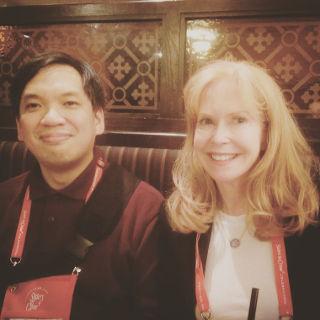 |
| Me and Shelly Dickson Carr (courtesy Gigi Pandian) |
 |
| L to R: Herschel, me, Shelly (courtesy Shelly Dickson Carr) |
 |
| Gigi Pandian and Josh Pachter (courtesy Shelly Dickson Carr) |
A final fun surprise of the con came when John McFetridge, whom I befriended on the last day of Bouchercon 2008, said I was mentioned in this year's Bouchercon short story anthology, Passport to Murder, which he edited. Having received a rejection for the story I submitted, I had to inquire further, and John explained that working on the anthology reminded him of a story he wrote for a flash fiction blog challenge I helped put together with Patricia Abbott and Aldo Calcagno years earler.
That's something, and I'm flattered, but there's no better feeling than using my words to achieve just the effects I aim for, that also resonate with editors and the general public. That's why I keep writing.
The best thing about Bouchercon is being among people who not only know and appreciate each other's writing but also their efforts off the page.
Saturday, August 12, 2017
From a Certain Point of View
© by Gerald So | 8:00 a.m.
I'm still working on a story originally submitted last December and rejected in May that I've been revising since June.
Consulting David Corbett's book The Art of Character and Lawrence Block's last collection of Writer's Digest columns The Liar's Companion, last week it occurred to me to change the viewpoint character, from an ex-cop to a woman who's reentered the ex-cop's life.
I have to show less of the ex-cop's deductive reasoning and emerging idea of the plot, but because the woman is involved in the plot itself, I get to show more of that, as well as her motives.
I'm still working on a story originally submitted last December and rejected in May that I've been revising since June.
Consulting David Corbett's book The Art of Character and Lawrence Block's last collection of Writer's Digest columns The Liar's Companion, last week it occurred to me to change the viewpoint character, from an ex-cop to a woman who's reentered the ex-cop's life.
I have to show less of the ex-cop's deductive reasoning and emerging idea of the plot, but because the woman is involved in the plot itself, I get to show more of that, as well as her motives.
Wednesday, June 21, 2017
Ups and Downs
© by Gerald So | 6:45 a.m.
I hope you've noticed I haven't blogged in almost a month. (Noticing means you check my blog.) The reason turns out to be good.
On May 28, I received a rejection for a story I submitted to an anthology almost six months earlier that saw me retool characters I created in a 1995 mystery novel writing workshop. I thought the work of revision took me to a different place as a writer. I was confident the story would be accepted to the anthology and that disappointed it wasn't.
For a day or two I did nothing but wonder if I should move on to a different project. The specific anthology theme gave me the idea to use the characters again at all. "Should I just forget them?" I asked.
Then, early one morning, I opened the rejected story file and just started writing, targeting it for Ellery Queen's Mystery Magazine or Alfred Hitchcock's Mystery Magazine. I figure, why not? These are the most mainstream mystery characters and story I've written. Yes, EQMM and AHMM are big game, the average word counts on their accepted stories four times longer than most I've published, but why not?
Giving myself that word count and standard of quality to hit, I'm trying to learn greater character and plot development by doing. Going to the keyboard any time of the day has been automatic. I'd rather be distracted by these characters than anything else.
So far, I've produced different length versions of the story, from 1,000 to 2,500 words. Currently I've worked back up to 1,500 words and will submit the length I think tells the story and showcases the characters best. Reading my drafts are three college friends who've known the characters as long as I have.
With luck, this venture will end in publication, but for now it's given me what's important, enthusiasm for the process.
I hope you've noticed I haven't blogged in almost a month. (Noticing means you check my blog.) The reason turns out to be good.
On May 28, I received a rejection for a story I submitted to an anthology almost six months earlier that saw me retool characters I created in a 1995 mystery novel writing workshop. I thought the work of revision took me to a different place as a writer. I was confident the story would be accepted to the anthology and that disappointed it wasn't.
For a day or two I did nothing but wonder if I should move on to a different project. The specific anthology theme gave me the idea to use the characters again at all. "Should I just forget them?" I asked.
Then, early one morning, I opened the rejected story file and just started writing, targeting it for Ellery Queen's Mystery Magazine or Alfred Hitchcock's Mystery Magazine. I figure, why not? These are the most mainstream mystery characters and story I've written. Yes, EQMM and AHMM are big game, the average word counts on their accepted stories four times longer than most I've published, but why not?
Giving myself that word count and standard of quality to hit, I'm trying to learn greater character and plot development by doing. Going to the keyboard any time of the day has been automatic. I'd rather be distracted by these characters than anything else.
So far, I've produced different length versions of the story, from 1,000 to 2,500 words. Currently I've worked back up to 1,500 words and will submit the length I think tells the story and showcases the characters best. Reading my drafts are three college friends who've known the characters as long as I have.
With luck, this venture will end in publication, but for now it's given me what's important, enthusiasm for the process.
Wednesday, December 07, 2016
It's All Good
© by Gerald So | 5:30 A.M.
I wanted to check in after falling off blogging in recent weeks. The last two of November, I proofed and published The Five-Two's fifth annual ebook of fifty-two crime poems.
I had a good Thanksgiving at my cousin's, closed out with the board game Pandemic, in which players cooperate as CDC members against worldwide outbreaks.
For Black Friday, I got great deals on DVDs of Lucifer Season 1 and The Big Bang Theory Season 9.
Finally, for the past week, I've been writing a story I'm going to submit to a food-based anthology. Fondly, it's brought back characters I created twenty-one years ago in a novel-writing class.
Thank you for your ongoing interest here.
I wanted to check in after falling off blogging in recent weeks. The last two of November, I proofed and published The Five-Two's fifth annual ebook of fifty-two crime poems.
I had a good Thanksgiving at my cousin's, closed out with the board game Pandemic, in which players cooperate as CDC members against worldwide outbreaks.
For Black Friday, I got great deals on DVDs of Lucifer Season 1 and The Big Bang Theory Season 9.
Finally, for the past week, I've been writing a story I'm going to submit to a food-based anthology. Fondly, it's brought back characters I created twenty-one years ago in a novel-writing class.
Thank you for your ongoing interest here.
Sunday, September 11, 2016
Recovery
© by Gerald So | geraldso.blogspot.com | 6:00 A.M.
If the September 11 never happened, I'd have a false sense of security that nothing of their magnitude could ever happen on U.S. soil. I'm sure many Americans felt the same. Maybe they've gone through the same progression of feelings I have: helplessness, fear, anger, acceptance.
Part of me will always wish the attacks hadn't happened, but from them I think the U.S. has slowly developed more awareness of what can happen, which has helped foil subsequent plots.
On the day itself, I was home on Long Island and heard about the plane hits via texts with friends. I was fortunate not to lose any friends or family that day, but I empathize with those who did. The written word has always been my best means of connecting with the world and with my feelings. While the act of writing leads me to the greatest empathy, the act of editing is an empathic leap above that of reading. It prods me to think critically about what's written, and my opinions affect the final product. Editing Dave White's Thrilling Detective story "Closure" was a test of how well I empathize. You be the judge.
A piece of writing is of the moment it's written. In the fourteen years since "Closure" was published, undoubtedly Dave has matured as a writer, but just as we'd all like to do the right thing in the right place at the right time, I'm grateful to have been in a position to help Dave polish "Closure".
If the September 11 never happened, I'd have a false sense of security that nothing of their magnitude could ever happen on U.S. soil. I'm sure many Americans felt the same. Maybe they've gone through the same progression of feelings I have: helplessness, fear, anger, acceptance.
Part of me will always wish the attacks hadn't happened, but from them I think the U.S. has slowly developed more awareness of what can happen, which has helped foil subsequent plots.
On the day itself, I was home on Long Island and heard about the plane hits via texts with friends. I was fortunate not to lose any friends or family that day, but I empathize with those who did. The written word has always been my best means of connecting with the world and with my feelings. While the act of writing leads me to the greatest empathy, the act of editing is an empathic leap above that of reading. It prods me to think critically about what's written, and my opinions affect the final product. Editing Dave White's Thrilling Detective story "Closure" was a test of how well I empathize. You be the judge.
A piece of writing is of the moment it's written. In the fourteen years since "Closure" was published, undoubtedly Dave has matured as a writer, but just as we'd all like to do the right thing in the right place at the right time, I'm grateful to have been in a position to help Dave polish "Closure".
Thursday, August 04, 2016
My Feelings on Fan Fiction
© by Gerald So | geraldso.blogspot.com | 9:30 A.M.
This week's 7 Criminal Minds question: What do you think about fan fiction? Have you ever written any yourself?
Fan fiction was long considered infringement on a creator's copyright because fans would write about characters without the creator's approval. I'm against that sense of fan fiction. I'm also against fan fiction in general because it puts off a writer's time working with his or her own characters, the most fulfilling part of writing.
Fan fiction should be distinguished from licensed tie-in or continuation novels, such as the post-Ian Fleming James Bond novels, Lee Goldberg's Diagnosis Murder and Adrian Monk novels, or Ace Atkins's Spenser novels, rightfully approved by the creator or the creator's estate. I approve of and have enjoyed many of these, but continuation authors are often overlooked in the shadows of the franchises for which they write. Developing and shopping your own franchise brings you the most credit.
Have I written fan fiction myself? In 1999 or 2000, before I was aware of copyright infringement, I frequented a message board for the short-lived 1998 TV show Vengeance Unlimited, which starred Michael Madsen as enigmatic do-gooder Mr. Chapel, who nonetheless may have been psychotic. Members of the board and I began to write a fan story one passage at a time. Another member of the board was a fellow Spenser fan, and she brought Spenser into the story. I contributed some passages with Spenser. Sometime after the show was canceled, the board shut down, and I posted the complete story to my website.
Lucky for me, I learned about copyright infringement and took the story down before any lawyers had to tell me.
This week's 7 Criminal Minds question: What do you think about fan fiction? Have you ever written any yourself?
Fan fiction was long considered infringement on a creator's copyright because fans would write about characters without the creator's approval. I'm against that sense of fan fiction. I'm also against fan fiction in general because it puts off a writer's time working with his or her own characters, the most fulfilling part of writing.
Fan fiction should be distinguished from licensed tie-in or continuation novels, such as the post-Ian Fleming James Bond novels, Lee Goldberg's Diagnosis Murder and Adrian Monk novels, or Ace Atkins's Spenser novels, rightfully approved by the creator or the creator's estate. I approve of and have enjoyed many of these, but continuation authors are often overlooked in the shadows of the franchises for which they write. Developing and shopping your own franchise brings you the most credit.
Have I written fan fiction myself? In 1999 or 2000, before I was aware of copyright infringement, I frequented a message board for the short-lived 1998 TV show Vengeance Unlimited, which starred Michael Madsen as enigmatic do-gooder Mr. Chapel, who nonetheless may have been psychotic. Members of the board and I began to write a fan story one passage at a time. Another member of the board was a fellow Spenser fan, and she brought Spenser into the story. I contributed some passages with Spenser. Sometime after the show was canceled, the board shut down, and I posted the complete story to my website.
Lucky for me, I learned about copyright infringement and took the story down before any lawyers had to tell me.
Friday, July 22, 2016
Baby, Remember My Name
© by Gerald So | geraldso.blogspot.com | 4:00 A.M.
This week's panel question at 7 Criminal Minds is, "Which would you choose, fame or fortune?"
It's got me thinking. While I'd love to make enough money to support myself and my extended family, I didn't pursue writing, particularly poetry, to make a fortune. I know many writers who began in poetry but largely gave it up when their work in other genres took off. Discovering my talent at 13, I began in fiction because it seemed safer footing than poetry.
In 2001, teaching at Hofstra University, I befriended poet Robert Plath. He wanted to create a faculty poetry website but didn't know how to code HTML. In helping Rob with the code, I read the submitted poetry with an editor's eye and got into writing some myself. My first print acceptance was not a story but the poem "Night School", originally in the Spring 2003 issue of Long Island Quarterly, reprinted on the Web in Red Fez.
Remembering that, I've consciously chosen to keep writing poetry along with whatever else I can. Every kind of writing feeds its own kind of creativity. Poetry, moreso than prose, approaches subjects from surprising, instantly personal angles, letting the poet's voice through unfiltered by narrative expectations.
Fame or fortune? I choose fame in the sense that I'd like to be known for my work. If I make a fortune in writing or elsewhere, I'll keep writing.
This week's panel question at 7 Criminal Minds is, "Which would you choose, fame or fortune?"
It's got me thinking. While I'd love to make enough money to support myself and my extended family, I didn't pursue writing, particularly poetry, to make a fortune. I know many writers who began in poetry but largely gave it up when their work in other genres took off. Discovering my talent at 13, I began in fiction because it seemed safer footing than poetry.
In 2001, teaching at Hofstra University, I befriended poet Robert Plath. He wanted to create a faculty poetry website but didn't know how to code HTML. In helping Rob with the code, I read the submitted poetry with an editor's eye and got into writing some myself. My first print acceptance was not a story but the poem "Night School", originally in the Spring 2003 issue of Long Island Quarterly, reprinted on the Web in Red Fez.
Remembering that, I've consciously chosen to keep writing poetry along with whatever else I can. Every kind of writing feeds its own kind of creativity. Poetry, moreso than prose, approaches subjects from surprising, instantly personal angles, letting the poet's voice through unfiltered by narrative expectations.
Fame or fortune? I choose fame in the sense that I'd like to be known for my work. If I make a fortune in writing or elsewhere, I'll keep writing.
Friday, August 28, 2015
The Good, The Bad, and The Negative
© by Gerald So | geraldso.blogspot.com | 4:00 A.M.
This week the 7 Criminal Minds bloggers discussed how they deal with bad reviews.
My feeling is, when I submit my work for publication, I voluntarily open it up to everyone who can read. And of course, not everyone is going to like it.
If I were writing just for my satisfaction, I'd write stuff, read it, smile, and put it in a drawer. I write for publication because I want to give others the enjoyment I get from reading. I'll never hear from everyone who enjoys my work, but it's enough to hear from a few. The enjoyment I try to give, the connection I try to make, is personal after all.
And let me distinguish bad reviews from negative reviews. Bad reviews fail to address my work, as bad light bulbs fail to light. Bad reviews are easily spotted and dismissed upon reading, but they unfairly and unfortunately count in a glance at numbers.
Negative reviews, on the other hand, are fair. They genuinely address my work and find it lacking.
Not everyone is going to like what I write. That doesn't stop me from writing.
This week the 7 Criminal Minds bloggers discussed how they deal with bad reviews.
My feeling is, when I submit my work for publication, I voluntarily open it up to everyone who can read. And of course, not everyone is going to like it.
If I were writing just for my satisfaction, I'd write stuff, read it, smile, and put it in a drawer. I write for publication because I want to give others the enjoyment I get from reading. I'll never hear from everyone who enjoys my work, but it's enough to hear from a few. The enjoyment I try to give, the connection I try to make, is personal after all.
And let me distinguish bad reviews from negative reviews. Bad reviews fail to address my work, as bad light bulbs fail to light. Bad reviews are easily spotted and dismissed upon reading, but they unfairly and unfortunately count in a glance at numbers.
Negative reviews, on the other hand, are fair. They genuinely address my work and find it lacking.
Not everyone is going to like what I write. That doesn't stop me from writing.
Saturday, August 15, 2015
Thank you, Steve Kowit
© by Gerald So | geraldso.blogspot.com | 7:00 A.M.
I looked in on poeticdiversity.org last night and was saddened to learn poet and teacher Steve Kowit had died, in his sleep on April 2, 2015, according to his website.
A few years out of graduate school, Kowit's In the Palm of Your Hand: The Poet's Portable Worshop showed me how to revise a flash of inspiration into a poem more people than just I might get, and how to conjure inspiration for a poem in the first place.
I never met or corresponded with Kowit, but his friendly voice comes through in his work and his website. Long may they draw audiences.
I looked in on poeticdiversity.org last night and was saddened to learn poet and teacher Steve Kowit had died, in his sleep on April 2, 2015, according to his website.
A few years out of graduate school, Kowit's In the Palm of Your Hand: The Poet's Portable Worshop showed me how to revise a flash of inspiration into a poem more people than just I might get, and how to conjure inspiration for a poem in the first place.
I never met or corresponded with Kowit, but his friendly voice comes through in his work and his website. Long may they draw audiences.
Thursday, July 30, 2015
Beginners and Continuing
© by Gerald So | geraldso.blogspot.com | 12:00 P.M.
Yesterday, SleuthSayers blogger Rob Lopresti brought up characters continued after their creators die. Citing Lawrence Block's remarks about Nero Wolfe continuation author Robert Goldsborough, Lopresti made a case against beginning writers copying their idols. Instead, Lopresti wrote, they should find their own voices.
Several of Rob's (and my) fellow Short Mystery Fiction Society members commented, echoing Rob's stance against continuation. In my comment, I agreed beginning writers shouldn't spend too long copying, but put in a good word for series continuation in general.
Yesterday, SleuthSayers blogger Rob Lopresti brought up characters continued after their creators die. Citing Lawrence Block's remarks about Nero Wolfe continuation author Robert Goldsborough, Lopresti made a case against beginning writers copying their idols. Instead, Lopresti wrote, they should find their own voices.
Several of Rob's (and my) fellow Short Mystery Fiction Society members commented, echoing Rob's stance against continuation. In my comment, I agreed beginning writers shouldn't spend too long copying, but put in a good word for series continuation in general.
Subscribe to:
Comments (Atom)